
Granite vs Quartz: Durability, Cost, Installation and Maintenance
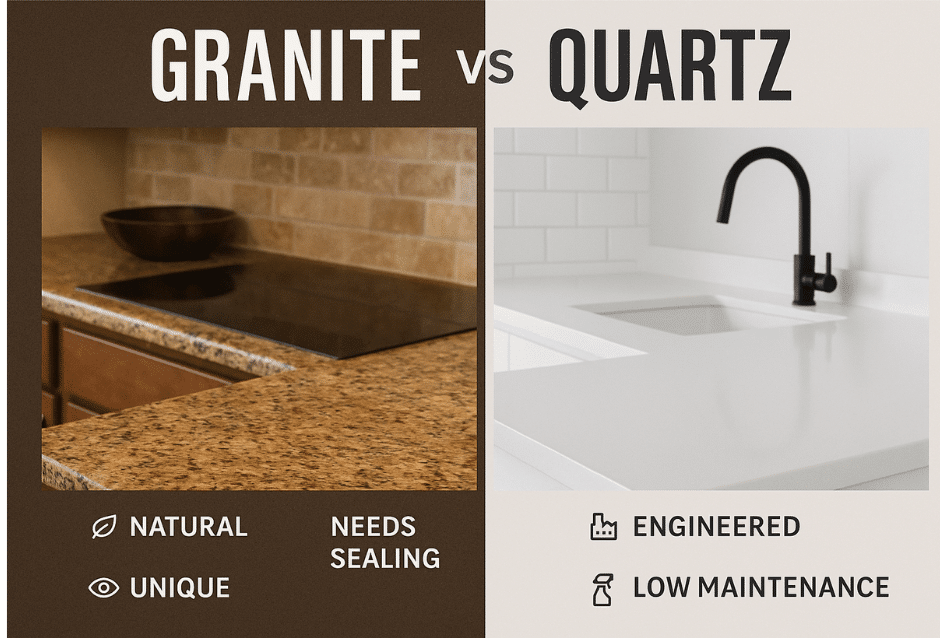
When you are renovating your kitchen or bathroom, material selection for good-quality slabs is a decision that not only affects your everyday life but also the long-term value of your home. Both granite and quartz have gained popularity in the market for their beautiful look, strength and durability. But there has been debate over the years about which is better, quartz or granite.
In this detailed comparison, we will compare these two materials in every important aspect—durability, cost, installation, design, and environmental impact. Apart from this, we will also ponder on how one can tell the difference between the quartz slab and the granite slab.
Let’s dig into understanding the difference between granite and quartz and find out which option is the best for your requirements.
Understanding countertop materials: Granite and Quartz
Characteristics of Granite
Granite is a fully natural stone that is quarried, transformed into slabs, and polished. Since granite slabs are mined individually, every granite countertop is unique. It is also one of the strongest stones with beautiful deep patterns and excellent resistance to heat.
Characteristics of Quartz
In contrast, quartz countertops are 100% artificial. They consist of more than 90% crushed quartz with resins and pigments, making them completely non-porous. They do not stain and cannot harbor bacteria. Moreover, quartz countertops have uniform colors and textures, making them customizable to the buyer’s preference. It is truly a perfect blend of nature and technology.
Difference in composition
Granite: Completely natural stone, porous, does not receive sealant after production.
Quartz: Composite material, non-porous, factory sealed.
These characteristics are crucial in caring and protecting against stains.
This difference plays a big role in its maintenance and protection from stains.
When it comes to their use in modern homes, granite countertops look great in traditional or rustic style kitchens, where their natural veining adds a different character to the space. Quartz countertops, on the other hand, are considered best for modern, minimalist and high-traffic homes as they are not only stain resistant, but their look is also very clean and stylish.
Durability : Quartz Durability vs Granite Durability
When we need to make a decision to choose between quartz and granite for kitchens and restrooms, durability is the most significant factor to consider. Both materials are very strong and long-lasting, but their performance is distinct in some areas. Below is the detailed comparison to help you decide to choose the best material for your choice:
| Aspect | Granite | Quartz | Winner |
| Scratch Resistance | Granite is a strong stone, but scratches the surface very easily. For example, when a knife is used on the granite countertop, it can be scratched easily. | Quartz, on the other hand, performs better in terms of scratches (tried and tested). This is because of its engineered composition, which makes it more uniform and resistant. | Quartz durability |
| Heat Resistance | Granite performs better than quartz in heat resistance. It is able to withstand a hot tawa or pan placed directly on it without damage. | Quartz contains resin, which can get damaged in high heat. So, it is recommended to use a trivet or mat on quartz. | Granite durability |
| Impact & Chip Resistance | Granite, on the other hand, can crack with a little more force or a heavy object falling suddenly. | Quartz is better in terms of impact and chip resistance. The resins present in it make it flexible, so it does not break easily. | Quartz durability |
| Stain Protection | Granite is porous and needs to be sealed every 1-2 years to prevent from further damage. | Quartz is unbeatable here. It won’t be stained because it is non-porous, and any liquid or spill will not absorb deeply. It is less likely to get stained, thus maintaining hygiene. | Quartz durability |
| Long Lasting | Lifespan—both materials are equal in this. With proper care and maintenance, quartz and granite countertops can last 20 to 30 years or even longer. | Lifespan—both materials are equal in this. With proper care and maintenance, quartz and granite countertops can last 20 to 30 years or even longer. | Tie |
This comparison clearly shows that quartz is a more practical and durable option for daily use and low maintenance, while granite still comes out on top when it comes to heat.
Cost Analysis of Quartz and Granite
When we compare quartz and granite, we need to consider not just the initial cost but also the maintenance, design options and resale value of the home. Below is a simple and clear comparison to help you make an informed and budget-friendly decision.
| Aspect | Granite | Quartz | Winner |
| Initial Investment | Costs between $40–$100 per sq. ft. Requires sealing every 1–2 years, which adds to maintenance cost. | Costs between $50–$120 per sq. ft. No sealing needed, reducing long-term maintenance expenses. | Quartz (cheaper to maintain) |
| Long-Term Value | Requires periodic sealing and care. Maintenance costs add up over time. | Non-porous, no sealing required, and low maintenance. Saves money over the years. | Quartz (more profitable) |
| Color & Design Options | Exotic granite designs increase the price. | Designer or rare quartz patterns also increase the price. | Tie |
| Edge Design Impact | “Rounded, slanted, or curved designed edges tends to increase the cost | “Rounded, slanted, or curved designed edges tends to increase the cost | Tie |
| Custom Features | Customizations like sink cutouts, backsplashes, or logos add to the cost—common in commercial use. | Same as granite—custom work adds cost, especially for commercial applications. | Tie |
| Resale Value Contribution | Adds elegance and value to the home. | Also adds value but has more appeal to modern buyers due to low maintenance and trend-friendly design. | Quartz (modern and desirable) |
Final verdict
If you want a countertop that looks beautiful, is reasonably priced, and will last for years without any hassles, quartz is the perfect choice for you.
Installation Process: Which Material Is Easier to Install?
Once you have purchased a countertop, the next critical step is its installation. Here is where a lot of customers wonder what the safest and easiest material to install. So, let us figure out what the differences in the installation procedure of quartz and granite are and which one would serve you better.
1. Weight and Structural Requirements
Granite and quartz are both very heavy materials. But granite is a little denser, which means it is a little heavier in weight. If your house is older or the kitchen cabinets are made of wood, then structural reinforcement may be required before installation.
To avoid any unexpected issues, it is prudent to speak with the builders or installation team ahead of time.
2. Professional Installation vs DIY
Granite is one of the strongest stones, but like any stone, it can break during transport or installation if not properly handled. For this reason, professionals should always handle granite installation.
Quartz is somewhat more flexible than granite, making its prefab slabs easier to install. Even so, professional installation is still preferred for achieving the best results.
If you want to DIY, quartz may be a slightly easier choice, but without expert help, tackling a large job can still be risky.
3. Time required
Quartz takes a little less time to install as it does not need post-installation sealing. Granite, on the other hand, needs to be sealed after installation, which adds both time and effort.
Winner: Quartz
Common installation challenges
Granite can crack or chip if lifted or dropped incorrectly. This is especially true if the slab is very thin or the long portion is unsupported.
Quartz is sensitive to UV or direct sunlight, so it should only be used for indoor applications. If you are building an outdoor kitchen, quartz would not be a good choice.
In today’s times, when people want to be both environmentally responsible and beautiful in their homes, it’s important to know how much of an impact your kitchen countertops are having on natural resources. Let’s find out where both materials, quartz and granite, stand environmentally.
1. Manufacturing Process
Granite is mined as large blocks, which are then cut and polished. The entire process is resource-intensive ,it requires heavy machinery, water and energy.
In comparison, quartz is produced in a controlled industrial process that combines crushed quartz, resin, and pigments to form slabs. The process is also scalable and produces less waste.
Result: Quartz (lower resource consumption and more controlled production)
2. Recyclability
Both materials—quartz and granite—are theoretically recyclable, but the waste generated during quartz fabrication is more easily managed.
On the other hand, granite cutting often results in irregularly shaped pieces that can be difficult to reuse.
Result: Quartz (for better waste management)
3. VOC emissions and indoor air quality
When installing any material indoors, its health benefits cannot be ignored.
If the resin used in quartz slabs is of good quality, it emits very low amounts of VOCs (Volatile Organic Compounds).Especially if the slab has a third-party certification like GREENGUARD Gold, it is considered completely safe.
Granite is a natural stone, but if it’s not properly sealed or contains gases like radon, it can affect indoor air quality.
Result: Quartz (for better health safety and cleaner indoor air)
Quartz vs Granite: How to Tell the Difference by Appearance?
If you look at a countertop and wonder if it is quartz or granite, you are not alone. Both materials look great, but there are some subtle differences that can help you immediately understand what is in front of you. Let’s understand their features in simple language:
1. Pattern Consistency
The design of quartz is completely controlled because it is an engineered material. Therefore, its patterns and colors are uniform and smooth, no matter how big a slab you look at. Marble-like veining, soft colors or sparkle designs are easily found in it.
Granite is a completely natural stone, so its patterns are unique and irregular. You will see a variety of different colors and stripes everywhere. This is also its natural beauty.
If the pattern looks the same and perfect, then it can be quartz. If it is slightly different everywhere, then it is granite.
2. Coolness to Touch
Granite is naturally cool when you touch it because it’s a natural stone and absorbs energy slowly. Quartz traps heat quickly, so it’s not as cold. If you feel cool when you place your hand on the countertop, it’s probably granite.
3. Seams Visibility
Quartz is easy to cut and fit, so it’s easy to hide seams. The uniformity of tone and pattern makes the seams blend in. Granite may have more visible seams, especially if it has very dark or different colored stripes. If the seams aren’t visible, it’s probably quartz, while granite may have slightly more visible seams.
4. Luster and Finish
Granite typically comes in a high-gloss finish, which is shiny, reflective and classic. Quartz can be found in matte, satin and high-gloss finishes, which means you can do more customization to suit your interior. If the countertop has a very shiny finish, it may be granite. If the finish is soft or matte, it’s likely quartz.
Quartz and granite – both countertops are great in their own right. But if you are looking for something beautiful, durable, and easy to maintain for a modern home, quartz should be your first choice.
If you too want to explore premium quality quartz countertops for your kitchen, then do check out the beautiful and high-performance range of Madhav Quartz.
What Makes Madhav Quartz the Best in the Business?
- Premium quality: Our Quartz slabs are made from 90% pure natural quartz, making them strong and durable.
- Amazing Designs: Whether you require classic white and black quartz or bold quartz veining, we provide perfect designs for every space and mood.
- Hygienic: Our slabs are non-porous, which means they will not get stained or infected with bacteria. Thus, it makes it perfect for safe, clean and easy maintenance.
- International Certifications – Madhav Quartz products are NSF, GREENGUARD Gold and ISO certified, making them compliant with international safety and quality standards.
- End-to-End Support – We not only sell slabs, but are with you every step of the way, from selection to installation and post-service.
When you choose quartz countertops for your home, office or commercial project, it is not just the visual appeal that counts, but quality and reliable services. This is why architects, interior designers and builders choose Madhav quartz.
Conclusion
Granite and quartz both serve as materials for countertops; the choice depends on the preference of personal taste. If you like natural beauty, granite is the best choice as it will bring an elegant look to your space. On the other hand, if you want a sleeker look and a modern appearance, quartz is more durable and requires less maintenance.
When it comes to buying quartz, Madhav Surfaces is the name you can trust. Whether you are upgrading your home or designing your commercial space, our premium quartz collection is the best for you. It is not only appealing to your eyes but also an investment that will last for years.
Frequently asked questions
1. Is quartz cheaper than granite?
Quartz and granite cost about the same, depending on the style and brand.
However, quartz saves money over time due to less maintenance.
2. What is the best countertop material?
Quartz is often considered the best for its strength, style, and easy care.
It’s non-porous, durable, and perfect for busy kitchens.
3. What is the most expensive countertop?
Marble and rare quartzite slabs are usually the priciest options.
Their beauty comes with high maintenance and cost.
4. Will quartz crack from heat?
Yes, sudden high heat can crack quartz due to thermal shock.
Always use trivets or hot pads under hot cookware.